We've talked about this before, but we are continually confronted with the issue, so we thought it worth putting out there for discussion: at what point did the antiques that people have hunted, loved, and lived with turn into mere dollar signs? More and more, we are talking to folks who tell wonderful stories of their decades of collecting, of getting to the flea market at 4:00 am and finding that great treasure, or nabbing an overlooked gem at auction. But now that it's time to sell their collections, they become rigidly fixated on money. No one ever told them that the antiques they purchased would be worth anything down the road, and back in the day, they wouldn't have cared...they just loved the stuff and wanted to take it home. Now, however, they are convinced that every antique they purchased should be worth at least what they paid for it, and they sometimes get visibly upset if you point out that the market has changed and this object or that object is less desirable, and therefore less valuable, than it was in 1980.
It almost feels like a betrayal. It's like the hippie who spent the 1960s attending anti-war protests and then shows up to his 30-year high reunion having become a corporate lawyer who doesn't know how to recycle. What happened? When did these antiques that you proclaimed your love for become mere commodities? At what point did your passion for history and art turn into a stubborn desire to squeeze every last penny out of your collection? And with that attitude becoming more and more prevalent, are we really surprised that younger folks aren't developing a love for antiques, a passion for living with historical objects??
Wednesday, June 9, 2010

Tuesday, May 25, 2010
It's auction week.
It's auction week at Garth's, Saturday being our annual Memorial Day auction, part of which (for four years now) has been devoted to objects from the Ohio River Valley.

Today also happens to be our monthly walk-in appraisal day. Between the two events, it's a great time to "people watch" in the marketplace. The saleroom is full of dealers and collectors of all kinds....trophy hunters, price buyers (folks who go after things if they're cheap, sometimes disparagingly called "bottom feeders" but these folks sometimes walk away with a real gem that was merely overlooked), and serious students of material culture. We also get the previewers who like to ask a zillion questions, sometimes because they genuinely want the answers, and sometimes simply to show off their knowledge and/or stump you.
And then there are the folks who bring their treasures to be evaluated by our appraisers. You never know what is going to walk through the door...we look at LOTS of handpainted china that is "real old and valuable" (according to grandma), but we also see some very interesting stuff (like a 17th century Tibetan bronze buddha). Yep, every month there is one person who KNOWS what their object is and when we disagree, they KNOW that they are right and we are wrong. But for the most part, we get nice folks who just want to know what something is.
The record price for an object brought in during our monthly appraisal day is just over $43,000 (the aforementioned buddha). It's only a matter of time before something eclipses that....
Tuesday, May 18, 2010
Seeing things differently...
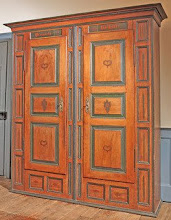
So a few weeks ago, I helped one of Garth's clients load up a piece of furniture that they had purchased in our March Americana auction. Here it is:

Not terribly impressive, right? It's only half a corner cupboard, is missing bits of molding, and has been badly refinished.
Well, the buyers, Dave and Jeanne Kessler, owners of Sandusky Street Antiques in Delaware, Ohio, had a good reason for buying it. Jeanne explained that when Dave first saw the thing, he thought, "Boy, that's just about perfect for a corner stand for a flatscreen tv." So, they bought it (very reasonably), Dave'll fix it up, and someone will get a good deal on a stylish, eco-friendly tv stand that will have resale value.
That's exactly the attitude and the vision we need in this business. In years past, you could find a collector that would happily purchase nearly every antique out there. These days, collectors are fewer and pickier. They've been convinced that they shouldn't be buying anything that doesn't fall somewhere on the good-better-best spectrum. As a result, there are truckloads of useful, attractive antiques languishing in antique shops, their owners frustrated because no one will give them a second look.
The trick, as we've said before, is to target non-collectors...users, folks who just want to live with interesting furnishings or furnishings that offer good value and aren't made in Chinese sweatshops. Dave and Jeanne have figured this out and are out there looking for the overlooked antiques that just might find a useful spot in a modern home. That's smart. That's the kind of flexibility that has allowed them to remain successful these past few years. And you never know...they just might ignite an interest in someone and turn a mere user into a collector!
Monday, April 26, 2010
Texas - The Shows
The shows - holy smokes, where to start? As mentioned, you can see a partial list on the Round Top Chamber of Commerce website, but in reality, it seems like everyone with a field, a barn or even just a large front lawn had tents and tables set up. We got in late Monday night and left very early Friday morning, but in our three full days, we managed to hit seven shows.
We started Tuesday morning at Marburger Farm (it's a lovely 43-acre setting with a mix of fairground-like pavilions and shelters and a number of historic buildings from around the area that have been relocated). You can see a map here of the grounds and there are photos of some of the neat buildings on their event site here. There were more than 350 dealers there, and while we can't say how many people attended, we can tell you that this large, historically well-attended show still actually ran out of printed tickets after about a day and a half because so many people showed up! Bottom line: people were allowed in about an hour before selling started and there was a line and there was running. Can't tell you the last time we saw that!
Wednesday, we went over to the Big Red Barn, which is also known as the "original Round Top Antiques show". Again, barns and tents full of stuff, and again with the crowds! Our first walk through the show, we were just shuffling along in the center of an aisle jammed with people. You could barely make it to the entrance to a booth, let alone get in and have a look around. Fortunately, we also managed to connect with dealers Kim and Mary Kokles, Texans themselves, and they helped make some suggestions about shows and meals we'd want to make time for. After a Royers lunch in the tents outside, we made the rounds to shows at the Carmine (Carmine is at a separate location some distance away, but the admission to Big Red Barn get you in there as well) and La Bahia dance halls, and circled back to get another look at Marburger Farm.
Thursday, we made stops at the Round Top Rifle Hall, Shelby and Cole's shows. The Cole's show is another large show - 200+ dealers in a 63,000-square-foot facility. And then back to Marburger Farm for the afternoon.
We started Tuesday morning
 at Marburger Farm (it's a lovely 43-acre setting with a mix of fairground-like pavilions and shelters and a number of historic buildings from around the area that have been relocated). You can see a map here of the grounds and there are photos of some of the neat buildings on their event site here. There were more than 350 dealers there, and while we can't say how many people attended, we can tell you that this large, historically well-attended show still actually ran out of printed tickets after about a day and a half because so many people showed up! Bottom line: people were allowed in about an hour before selling started and there was a line and there was running. Can't tell you the last time we saw that!
Wednesday, we went over to the Big Red Barn, which is also known as the "original
 Round Top Antiques show". Again, barns and tents full of stuff, and again with the crowds! Our first walk through the show, we were just shuffling along in the center of an aisle jammed with people. You could barely make it to the entrance to a booth, let alone get in and have a look around. Fortunately, we also managed to connect with dealers Kim and Mary Kokles, Texans themselves, and they helped make some suggestions about shows and meals we'd want to make time for. After a Royers lunch in the tents outside, we made the rounds to shows at the Carmine (Carmine is at a separate location some distance away, but the admission to Big Red Barn get you in there as well) and La Bahia dance halls, and circled back to get another look at Marburger Farm.
After that, we drove by the marketplace at Warrenton, but weren't honestly brave enough to stop! It was a madhouse,  tents set up in fields on either side of the road as far as the eye could see in just about any direction. After seeing it and fresh from visiting all the other shows, we found ourselves speculating about what percentage of the North American antiques market would be destroyed by an atomic bomb going off at the stoplight in downtown Round Top. So. Much. Stuff.
 tents set up in fields on either side of the road as far as the eye could see in just about any direction. After seeing it and fresh from visiting all the other shows, we found ourselves speculating about what percentage of the North American antiques market would be destroyed by an atomic bomb going off at the stoplight in downtown Round Top. So. Much. Stuff.
Thursday, we made stops at the Round Top Rifle Hall, Shelby and Cole's shows. The Cole's show is another large show - 200+ dealers in a 63,000-square-foot facility. And then back to Marburger Farm for the afternoon.
Sunday, April 11, 2010
The Oglebay Show
Just back from a great weekend at Oglebay Park in Wheeling, West Virginia at the 56th annual Oglebay Antiques Show. They kindly invited us to offer a couple of talks: "Plugged In: Collecting in the Digital Age" and "Antiques are Green." Thanks to all those who attended!
As promised to those in the "Plugged In" talk, here are those links:
eBay: www.ebay.com
ArtFact: www.artfact.com (price database and live auction interface)
LiveAuctioneers: www.liveauctioneers.com (live auction interface)
AskArt: www.askart.com (price database for fine art)
Prices 4 Antiques: www.p4a.com (price database for antiques, art and collectibles)
And for those who attended the "Green" talk, some asked about the 3/50 project: www.the350project.net/home.html.
And for those of you who took one of our cards, email either of us for your free p4A trial, free Garth's catalog (and/or to be added to our email list), or free trial subscription to Maine Antique Digest.
Monday, April 5, 2010
Texas - The Food
What would travel be without good food? Fortunately, there was plenty to choose from in Texas, which was a good thing, because with so much walking to do, we had to work hard at staying fortified and hydrated!
Many of the shows (and there are, just on the Round Top Chamber of Commerce website, more than 20 listed during the two-week period in spring) have their own concessions, so you'll get a variety of opinions on what's best. There's barbecue at Marburger Farm, but some will tell you that you should head down to Round Top for the Methodist Men's barbecue. Andrew was also very fond of his vegetarian tacos at Marburger, but as he pointed out, handmade fresh tortillas make everything taste great. And with a rich local German heritage, if barbecue's not your thing, you'll find great German and other local foods and desserts at the Carmine Dance Hall, La Bahia, and Shelby shows.
For dinner, we got as much local variety as we could with only three nights, having dinner one evening at the Stone Cellar in Bybee Square, where you can get good pizza, wine and beer, and making the trip over to Brenham by the scenic route one night for some excellent and affordable Italian (in a great repurposing of an old house) at Volare.
But if you go to Round Top, you'll likely be told that Royers Round Top Cafe is a local must with a restaurant right in the center of downtown. We had dinner there on our first night with some lovely folks - out in the evening air, perched on hay bales, as the crowd worked their way through stir-fried vegetable pasta dishes, marinated pork and quail, and shrimp BLT sandwiches (see the photo, courtesy of our hose, Rick McConn of the Marburger Farms Show). Royers offers concessions at a number of the antiques shows, including the Big Red Barn show, during the day as well, so it's a great opportunity to have a little taste before committing for a full dinner. The real reason to go to Royers, however, is their pie....
Many of the shows (and there are, just on the Round Top Chamber of Commerce website, more than 20 listed during the two-week period in spring) have their own concessions, so you'll get a variety of opinions on what's best. There's barbecue at Marburger Farm, but some will tell you that you should head down to Round Top for the Methodist Men's barbecue. Andrew was also very fond of his vegetarian tacos at Marburger, but as he pointed out, handmade fresh tortillas make everything taste great. And with a rich local German heritage, if barbecue's not your thing, you'll find great German and other local foods and desserts at the Carmine Dance Hall, La Bahia, and Shelby shows.
For dinner, we got as much local variety as we could with only three nights, having dinner one evening at the Stone Cellar in Bybee Square, where you can get good pizza, wine and beer, and making the trip over to Brenham by the scenic route one night for some excellent and affordable Italian (in a great repurposing of an old house) at Volare.
But if you go to Round Top, you'll likely
 be told that Royers Round Top Cafe is a local must with a restaurant right in the center of downtown. We had dinner there on our first night with some lovely folks - out in the evening air, perched on hay bales, as the crowd worked their way through stir-fried vegetable pasta dishes, marinated pork and quail, and shrimp BLT sandwiches (see the photo, courtesy of our hose, Rick McConn of the Marburger Farms Show). Royers offers concessions at a number of the antiques shows, including the Big Red Barn show, during the day as well, so it's a great opportunity to have a little taste before committing for a full dinner. The real reason to go to Royers, however, is their pie....
Texas - The Countryside

We're baaack! Last week was a whirlwind week in the Round Top, Texas area for the shows. "Shows," by the way, seems to be a huge understatement, but more on that in the next few posts. We saw and did so much in three days that we're splitting it up a bit: countryside, shows, food, and marketplace. You'll want to be on the lookout for the upcoming column, too, as we'll go into a bit more detail, but we took so many photos that we wanted to share a bit here.

Back in the fall, we got a kind invitation from Rick McConn, one of the new owners of the Marburger Farm show, to come to Texas and see what they're up to down there, as they've been working hard at drawing a new crowd. Having never been and knowing how many shows there were, how could we say no? So, Monday afternoon we headed south, and after a delay in Chicago, we landed about 8:30 local time. Picked up our rental car (ridiculously small - it's the white speck in the photo) and managed to find our way through the Texas dark, which, by the way, is really dark, to our cabin.

We can't tell you where we stayed. Well, we could, but we'd have to kill you. Apparently, accommodations are slim pickings during the show weeks, so a friend said we might want to keep that information to ourselves if we ever, ever, ever want to have a shot at staying there again. But it was a cute little place over a pond, as you can see, and we went to bed to the croaking of frogs and woke up to the bawling of cattle.

Texas in late summer may well be hell on earth, depending on who you ask, but if that's true, then Texas in spring is certainly heaven on earth. Fresh breezes blew steadily, the sun was always shining (although very gentle on our pasty winter-whiten Midwestern skin), and bluebonnets were everywhere. When you pair that with more antique shows and good food than you can shake a stick at, you shouldn't be asking yourself why would you
 go to Texas, but rather why would you not?
Check back for more on food, shows, and a general perspective on the marketplace in the next few days....

Subscribe to:
Posts (Atom)