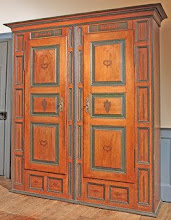
You'll see in our upcoming column that we are not confident in the future of collecting. Well, there will always be collectors, and they will always be an integral and crucial part of the marketplace. And there will be large numbers of collectors again...someday, just not in the immediate future. So, where does that leave the next generation of the marketplace? We need to focus on the users, the decorators, the folks who might just buy one or two antiques, or who might even fill up their entire house, but not as collectors, but as folks who just want to decorate with antiques.
The new Magazine Antiques just landed in our mailbox and it was great to see editor-in-chief Elizabeth Pochoda agree. "I'm not sure that collecting per se is the right focus for the campaign," she says in her discussion of a new trade organization that is forming. She further suggests that going after collectors might not be the best use of our resources, but "it is...possible that numbers of people will simply consider furnishing their lives with something old if they see it in a new light."
That's our job...to make the wider public see this stuff in a new light. Antiques are green, they are good value, they are timeless design, they are so many things. Let's move away from focusing on collecting them and refocus on simply living with them. That, folks, is the future of this marketplace.
Sunday, November 14, 2010

Sunday, October 31, 2010
It's just as good...
I (Andrew) love Halloween. It's always been my favorite holiday. As an adult, it's because it's the epitome of fall--cool and colorful, and well, I also love horror flicks. As a kid, of course, it was the costumes. My mother was a real "Martha" when it came to Halloween costumes. Sure, I went as a vampire several years, but one year I also went as an octopus. Mom made me a costume that consisted of a hood/mask and eight stuffed and sewn arms. It was fabulous.
In 5th grade, I went as "The Generic Kid." White pants labeled "PANTS", white shirt labeled "SHIRT", well, you get the idea. See, I grew up in middle-class suburbia, so generic products (complete with white labels and plain black lettering: "GREEN BEANS") were a staple of life. We complained. We wanted Del Monte vegetables and Nike shoes. "No," my mother would say, "These are cheaper and they are just as good." In my whitebread world, my costume needed no explanation. In fact, it was the hit of the party.
Where am I going with this? Recently, we got an email from a faithful reader (thanks for reading!) who does not see a new generation of collectors (and, frankly, we're not sure we do either...be sure to read our next column). This reader suggests that the unique-ness of antiques confounds younger folks, and he may be right. We grew up in a big-box environment, where everything is the same. One TV is just as good as the next. So now, why would a 30-something think of anyplace other than a big-box store to purchase generic furnishings for their cookie-cutter house? Even if you are choosing between the $399 sofa and the $699 sofa, they both often look exactly the same. Not so with antiques, so many choices, so much variety, it jars the senses of those who are used to mass-produced, plain vanilla mediocrity. In the world of antiques, everything is different and nothing is "just as good."
How do we overcome this? Perhaps we need to completely overhaul our business model. In a recent opinion column in The New England Antiques Journal, John Fiske suggested looking to mainstream retailers and their sales and advertised discounts. It may feel weird to us in the trade who are use to bidding and haggling, but if we want new buyers, we may need to create an environment in which today’s retail buyers are comfortable. You might not like the idea, but having a “Everything 25% Off” banner in your booth might just draw in a few more buyers. It's worth a shot, isn't it?
(I do, take issue, dear reader, with your comment that all young people are all "cheapskates." We are not cheapskates, we are simply in debt. The average college graduate in 2010 begins their adult life with over $20,000 in student loan debt. I just paid off my undergraduate education this past summer...14 years after I graduated. Now, it's on to my grad school loans.)
Sunday, October 17, 2010
Yet another show about the antiques market
Anyone catch the premier of Auctioneer$ on TLC last night? Ack! It was terrible! I won't go into a full-on rant, but the bottom line is that it is yet another show that does not accurately reflect the antiques market. Seriously, what auctioneer is going to recommend spending $250 to repair a $650 object? And what auctioneer has the time to "test" to make sure everything they sell works? And in no way would any responsible auctioneer actually give any credence to a certificate of authenticity that looks like it was printed up on an HP DeskJet. Don't get me wrong, I think it's super-fabulous that such shows are getting regular Joe and Jane Sixpacks out there interested in antiques, but I am beyond concerned with how they are doing it.

Sidenote: the Lincoln hair...it brought over $1000 when these yahoos sold it, and that's the high end for that thing. But rare? Nope...check eBay, there are a handful there right now. I've seen many of these, often framed the exact same way, and typically carrying impressive provenance, including the great collector Malcolm Forbes, and all the way back to a Caroline Wright who died in the 19th century. I think what has happened is that someone bought THIS LOT at the Malcolm Forbes sale at Christie's in 2002. Based on the price, I suspect the buyers didn't think much of the authenticity. And then, someone later, for some unknown reason, split up the locks and framed them in groups of several strands and sold them off. They may have made good money, but now tell me, how do I know that the hair that just sold on Auctioneer$ is actually from that group? Once it's left the annotated envelope, how can you be sure? (BTW, the image above is of another frame of Lincoln hair..this one sold at Alexander Autographs early this year for less than $400.)

Sidenote: the Lincoln hair...it brought over $1000 when these yahoos sold it, and that's the high end for that thing. But rare? Nope...check eBay, there are a handful there right now. I've seen many of these, often framed the exact same way, and typically carrying impressive provenance, including the great collector Malcolm Forbes, and all the way back to a Caroline Wright who died in the 19th century. I think what has happened is that someone bought THIS LOT at the Malcolm Forbes sale at Christie's in 2002. Based on the price, I suspect the buyers didn't think much of the authenticity. And then, someone later, for some unknown reason, split up the locks and framed them in groups of several strands and sold them off. They may have made good money, but now tell me, how do I know that the hair that just sold on Auctioneer$ is actually from that group? Once it's left the annotated envelope, how can you be sure? (BTW, the image above is of another frame of Lincoln hair..this one sold at Alexander Autographs early this year for less than $400.)
Tuesday, October 5, 2010
Repurposing
Did you know that new babies are a lot of work? What use to be the 5:00 am blog posting has now become the 5:00 am feeding and/or diaper change. But, we're getting back on track...
In Garth's recent Americana auction, this sideboard brought pretty good money. Okay, well, $4,700 may not be what some folks would call a good price, but in today's market, especially for an object related to formal dining (most such objects have taken a serious dive since formal dining is not happening much at home anymore), it's a very good price.

Why did this piece of "brown wood" sell for more than its estimate? Because of the creative vision of one of the bidders. In their mind, this wasn't a sideboard, but a perfect surface on which to put their new 60" flatscreen tv.
 TiVo, DVD players, etc. will fit nicely behind the center doors, and there is plenty of media storage space. I was so pleased to help this bidder envision this sideboard in her family room. It's repurposing at its finest. And it's something we are already doing at our house--a pie safe serves as the entertainment center, a step-back cupboard base is the perfect size and height for a changing table for Baby Nora, and there is no better coffee table in the world than an antique blanket chest.
Auctioneers and dealers need to start thinking like this, and presenting the objects they sell in a manner that is more relevant to today's lifestyles. Fewer folks, especially younger folks, are buying "art" and thus won't plunk down big bucks for a candlestand that serves no function purpose (seriously, is there any less practical piece of furniture?), but everyone needs to store their underwear and everyone needs a place to put their electronics. It's a new market, it's time we all get a new vision.
In Garth's recent Americana auction, this sideboard brought pretty good money. Okay, well, $4,700 may not be what some folks would call a good price, but in today's market, especially for an object related to formal dining (most such objects have taken a serious dive since formal dining is not happening much at home anymore), it's a very good price.

Why did this piece of "brown wood" sell for more than its estimate? Because of the creative vision of one of the bidders. In their mind, this wasn't a sideboard, but a perfect surface on which to put their new 60" flatscreen tv.
 TiVo, DVD players, etc. will fit nicely behind the center doors, and there is plenty of media storage space. I was so pleased to help this bidder envision this sideboard in her family room. It's repurposing at its finest. And it's something we are already doing at our house--a pie safe serves as the entertainment center, a step-back cupboard base is the perfect size and height for a changing table for Baby Nora, and there is no better coffee table in the world than an antique blanket chest.
Auctioneers and dealers need to start thinking like this, and presenting the objects they sell in a manner that is more relevant to today's lifestyles. Fewer folks, especially younger folks, are buying "art" and thus won't plunk down big bucks for a candlestand that serves no function purpose (seriously, is there any less practical piece of furniture?), but everyone needs to store their underwear and everyone needs a place to put their electronics. It's a new market, it's time we all get a new vision.
Sunday, September 12, 2010
Another rant...sorry.
Perhaps it's because I first saw the ad in the middle of the night (new baby Nora is a nightowl) and I was grumpy, but a recent commercial for Ikea really annoyed me (at least as much as the recent Restoration Hardware catalog). The commercial showed a number of rooms decorated in the Ikea style (which includes many crappy knock-offs styled after antiques) and the tagline at the end: Ikea--Life Improvement Store.
What about Ikea improves anyone's life? Okay, so it's cheap and convenient and in some small way that may be a modest improvement over 1970s paisley furniture from Goodwill. But let's really think about how a chair or a sofa from Ikea improves your life. Firstly, it's cheaply made using eco-irresponsible materials. True, that may not impact you right now, but let's face it, it will eventually. Secondly, you have to assemble it. If you have ever assembled any piece of mass-produced furniture, you already know that this process will NOT improve anything about your life (in fact, it'll ruin your weekend, most likely). Thirdly, once you bought it, it's monetary value is precisely zilch. Have you ever seen Ikea furniture at a garage sale? A quick search on Columbus, Ohio's Craig's List found a couple hundred Ikea objects for sale, mostly at a teeny tiny fraction of their original price. Of course, the reality is, your Ikea purchase won't last long enough to make it to a garage sale, unless you're planning one for next weekend. The stuff is so cheap that as soon as you assemble your new chair, you should probably immediately start planning on replacing it.
Am I being harsh? You betcha. We in the antiques industry need to set our sights on the likes of Ikea...they are the ones attracting potential young collectors (or simply young folks interested in classic style). We simply have to talk louder and in one voice about antiques in terms of their green-ness, quality, style, retained value, etc. etc. If we don't start acting boldly and immediately, we are in trouble.
What about Ikea improves anyone's life? Okay, so it's cheap and convenient and in some small way that may be a modest improvement over 1970s paisley furniture from Goodwill. But let's really think about how a chair or a sofa from Ikea improves your life. Firstly, it's cheaply made using eco-irresponsible materials. True, that may not impact you right now, but let's face it, it will eventually. Secondly, you have to assemble it. If you have ever assembled any piece of mass-produced furniture, you already know that this process will NOT improve anything about your life (in fact, it'll ruin your weekend, most likely). Thirdly, once you bought it, it's monetary value is precisely zilch. Have you ever seen Ikea furniture at a garage sale? A quick search on Columbus, Ohio's Craig's List found a couple hundred Ikea objects for sale, mostly at a teeny tiny fraction of their original price. Of course, the reality is, your Ikea purchase won't last long enough to make it to a garage sale, unless you're planning one for next weekend. The stuff is so cheap that as soon as you assemble your new chair, you should probably immediately start planning on replacing it.
Am I being harsh? You betcha. We in the antiques industry need to set our sights on the likes of Ikea...they are the ones attracting potential young collectors (or simply young folks interested in classic style). We simply have to talk louder and in one voice about antiques in terms of their green-ness, quality, style, retained value, etc. etc. If we don't start acting boldly and immediately, we are in trouble.
Tuesday, September 7, 2010
The newest young collector
Arrived last evening. Baby Nora and her mother are both perfect and healthy. Her father is. just. wow.
Saturday, August 28, 2010
The real competition
Recently, I've been having a riveting, albeit blood pressure-raising, conversation with an Indiana friend in the trade. He received the newest Pottery Barn catalog where they are hawking bad reproductions of 19th-century printer's chests and other things very clearly based on antiques. It's almost like they look through auction catalogs or go to shows to get inspired, and then send the plans to China to cheaply manufacture knock-offs.
And then the new Restoration Hardware catalog landed in both of our mailboxes. Hoo-boy...have you all seen this? Gary Friedman, the CEO, states, "No longer mere 'retailers' of home furnishings, we are 'curators' of the best historical design the world has to offer."
Um..excuse me? Seriously? I don't know what's more offensive, the fact that he described himself as a curator or that he claimed to have stuff that's better designed than the originals that his company has so poorly imitated.
I'm terribly sorry to inform you, Mr. Friedman, but if you want to find the curators of the best historical design, you need to look at places like Winterthur, the Met, and the MFA-Boston, as well as at antique auctions and shows around the country. Additionally, your customers would be better served by going to auctions, shows, and flea markets, where they will find better design AND better quality, all for a better price and in objects that will be worth something in 10 years.
Folks, you want to know where the (potential) young collectors are? They are at Pottery Barn, Target, Ikea, and they are shopping via catalogs like Restoration Hardware. They may not be as interested in history or art as you are or we are, but they are interested in style, quality, and price...and they aren't finding the best at those places, although they think they are. We need to get their attention and draw it to our business. So next time you see a Pottery Barn catalog on the coffee table of a friend or relative, surreptitiously swap it with an auction catalog or a copy of Maine Antique Digest, The Magazine Antiques or Antiques and Fine Art.
(And to my museum friends, you need to raise a stink with American Association of Museums...they need to protect the title "curator" the way that the American Library Association protects the title "librarian.")
And then the new Restoration Hardware catalog landed in both of our mailboxes. Hoo-boy...have you all seen this? Gary Friedman, the CEO, states, "No longer mere 'retailers' of home furnishings, we are 'curators' of the best historical design the world has to offer."
Um..excuse me? Seriously? I don't know what's more offensive, the fact that he described himself as a curator or that he claimed to have stuff that's better designed than the originals that his company has so poorly imitated.
I'm terribly sorry to inform you, Mr. Friedman, but if you want to find the curators of the best historical design, you need to look at places like Winterthur, the Met, and the MFA-Boston, as well as at antique auctions and shows around the country. Additionally, your customers would be better served by going to auctions, shows, and flea markets, where they will find better design AND better quality, all for a better price and in objects that will be worth something in 10 years.
Folks, you want to know where the (potential) young collectors are? They are at Pottery Barn, Target, Ikea, and they are shopping via catalogs like Restoration Hardware. They may not be as interested in history or art as you are or we are, but they are interested in style, quality, and price...and they aren't finding the best at those places, although they think they are. We need to get their attention and draw it to our business. So next time you see a Pottery Barn catalog on the coffee table of a friend or relative, surreptitiously swap it with an auction catalog or a copy of Maine Antique Digest, The Magazine Antiques or Antiques and Fine Art.
(And to my museum friends, you need to raise a stink with American Association of Museums...they need to protect the title "curator" the way that the American Library Association protects the title "librarian.")
Subscribe to:
Posts (Atom)