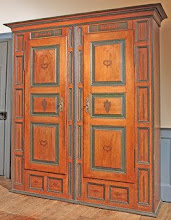
Recently, I've been having a riveting, albeit blood pressure-raising, conversation with an Indiana friend in the trade. He received the newest Pottery Barn catalog where they are hawking bad reproductions of 19th-century printer's chests and other things very clearly based on antiques. It's almost like they look through auction catalogs or go to shows to get inspired, and then send the plans to China to cheaply manufacture knock-offs.
And then the new Restoration Hardware catalog landed in both of our mailboxes. Hoo-boy...have you all seen this? Gary Friedman, the CEO, states, "No longer mere 'retailers' of home furnishings, we are 'curators' of the best historical design the world has to offer."
Um..excuse me? Seriously? I don't know what's more offensive, the fact that he described himself as a curator or that he claimed to have stuff that's better designed than the originals that his company has so poorly imitated.
I'm terribly sorry to inform you, Mr. Friedman, but if you want to find the curators of the best historical design, you need to look at places like Winterthur, the Met, and the MFA-Boston, as well as at antique auctions and shows around the country. Additionally, your customers would be better served by going to auctions, shows, and flea markets, where they will find better design AND better quality, all for a better price and in objects that will be worth something in 10 years.
Folks, you want to know where the (potential) young collectors are? They are at Pottery Barn, Target, Ikea, and they are shopping via catalogs like Restoration Hardware. They may not be as interested in history or art as you are or we are, but they are interested in style, quality, and price...and they aren't finding the best at those places, although they think they are. We need to get their attention and draw it to our business. So next time you see a Pottery Barn catalog on the coffee table of a friend or relative, surreptitiously swap it with an auction catalog or a copy of Maine Antique Digest, The Magazine Antiques or Antiques and Fine Art.
(And to my museum friends, you need to raise a stink with American Association of Museums...they need to protect the title "curator" the way that the American Library Association protects the title "librarian.")
Saturday, August 28, 2010
Saturday, August 21, 2010
We've got a "problem"
That chest of drawers has problems.
The chair is period, but is problematic.
Most of the stuff in that guy's collection has major problems.
Does this sound familiar? We hear comments like these all around the marketplace: at shows, at auctions, everywhere. What, exactly, are "problems" in the context of antiques? Generally speaking, condition issues and/or restoration. What we want to know is why something that is present in the vast majority of authentic antiques is a problem. If a 200-year-old blanket chest survives to today in totally original condition, without a bit of damage or repair, then it's a miracle and the price typically reflects this. But if it has a replaced back foot, all of a sudden it's "problematic." Why is this?
It seems to us that an authentic antique, even if it has significant restoration, is a good thing. So why do we condemn a restored object with a word like "problem?" Doesn't this make most antiques undesirable? After all, who wants to own a problem? (We do, of course, believe that fake or fraudulent objects, or those that have been "dressed up" or restored in a deceptive way can be problems, unless they are bought and sold as exactly what they are.)
It's only a word, yes, and in 21st-century America, we often get overly sensitive about words. But we're not talking about a misguided attempt to be politically correct, and we certainly aren't suggesting that we should start saying "the P-word." We are, however, saying that by using overly negative words to describe perfectly authentic antiques, we are demeaning them. We are not creating an environment in which these wonderful objects-objects that have lived lives and been used and even loved-are desirable. And aren't we, as auctioneers and dealers, suppose to be creating a desire to own these things?
What do you think?
The chair is period, but is problematic.
Most of the stuff in that guy's collection has major problems.
Does this sound familiar? We hear comments like these all around the marketplace: at shows, at auctions, everywhere. What, exactly, are "problems" in the context of antiques? Generally speaking, condition issues and/or restoration. What we want to know is why something that is present in the vast majority of authentic antiques is a problem. If a 200-year-old blanket chest survives to today in totally original condition, without a bit of damage or repair, then it's a miracle and the price typically reflects this. But if it has a replaced back foot, all of a sudden it's "problematic." Why is this?
It seems to us that an authentic antique, even if it has significant restoration, is a good thing. So why do we condemn a restored object with a word like "problem?" Doesn't this make most antiques undesirable? After all, who wants to own a problem? (We do, of course, believe that fake or fraudulent objects, or those that have been "dressed up" or restored in a deceptive way can be problems, unless they are bought and sold as exactly what they are.)
It's only a word, yes, and in 21st-century America, we often get overly sensitive about words. But we're not talking about a misguided attempt to be politically correct, and we certainly aren't suggesting that we should start saying "the P-word." We are, however, saying that by using overly negative words to describe perfectly authentic antiques, we are demeaning them. We are not creating an environment in which these wonderful objects-objects that have lived lives and been used and even loved-are desirable. And aren't we, as auctioneers and dealers, suppose to be creating a desire to own these things?
What do you think?
Friday, August 13, 2010
We're back...sort of...
Wow. The past 6 weeks have been a real roller coaster. Lots of travel (west and south), a death in the family, and 2 auctions. And, of course, there is the ongoing preparations for the arrival of the newest young collector, who is due any day now. So, as we wait and then adjust to our fabulous new life, our appearance here may be a bit irregular. Check back regularly, read our columns (the next two will be based on our trip to the New Orleans Antiques Forum), and be sure to pass around The Top Ten Reasons to Buy Antiques (links to the pdf are below and under our Fav Links).
Friday, July 16, 2010
Top Ten Reasons to Buy Antiques
As promised in our recent column in MAD, here is a free .pdf copy of our Top Ten Reasons to Buy Antiques. Feel free to email it, print it, pass it around, post it on shop windows or utility poles, link to it, whatever (just please do not change it).
Tuesday, July 13, 2010
Sorry folks...
that we've been absent. It's been a crazy few weeks (good and bad), but we'll be getting back to normal soon....
Monday, June 21, 2010
The rebound
It seems that the market has turned a corner. Over the past several months, we've noticed an uptick in the number of folks at auctions and shows, but more importantly, there seems to be more bidding and buying going on...and the bidding and buying feels less hesitant, even enthusiastic. There are still occasional soft spots, to be sure, but overall, folks seem excited to be buying antiques again.
That, of course, does not mean that we're anywhere close to the market of the 1990s. By now, we all know that was a bubble and the bubble has burst. It may take a long while for prices to get back to those levels, if they ever do (unless driven there by inflation). And even if they do, trends are changing. Furniture, particularly "brown furniture", even if very good, can still be a little hit-or-miss at auction, but "smalls" are still doing well. This is most likely because veteran collectors can always find room for another redware plate or another folk-carved bird, but one can only have so many corner cupboards.
Are you noticing this resurgence where you are??
That, of course, does not mean that we're anywhere close to the market of the 1990s. By now, we all know that was a bubble and the bubble has burst. It may take a long while for prices to get back to those levels, if they ever do (unless driven there by inflation). And even if they do, trends are changing. Furniture, particularly "brown furniture", even if very good, can still be a little hit-or-miss at auction, but "smalls" are still doing well. This is most likely because veteran collectors can always find room for another redware plate or another folk-carved bird, but one can only have so many corner cupboards.
Are you noticing this resurgence where you are??
Sunday, June 13, 2010
Some interesting events coming up in the next 12 months
One of the best parts of collecting, in our minds anyway, is learning. And some of the best places to learn are at museums and conferences. With that in mind, here is a short list of some upcoming events that might be of interest:
Early August: New Orleans Antiques Forum, sponsored by The Historic New Orleans Collection. This year, learn about Creole and Acadian furniture.
February: Colonial Williamsburg Antiques Forum. In its 63rd year. The 2011 topic: decorative arts forensics...the nuts and bolts of researching this stuff.
March: Winterthur Furniture Forum. This year, it'll highlight the arts and crafts of southeastern Pennsylvania to coincide with a major exhibition and catalog by curators Wendy Cooper and Lisa Minardi.
January-June: exhibition of early Ohio decorative arts at the Decorative Arts Center of Ohio. Everything from furniture to glass to samplers from 1788-1860. Check DACO's website for details as they become available.
May: Conference on Midwestern decorative arts (still in development...stay tuned for details).
Early August: New Orleans Antiques Forum, sponsored by The Historic New Orleans Collection. This year, learn about Creole and Acadian furniture.
February: Colonial Williamsburg Antiques Forum. In its 63rd year. The 2011 topic: decorative arts forensics...the nuts and bolts of researching this stuff.
March: Winterthur Furniture Forum. This year, it'll highlight the arts and crafts of southeastern Pennsylvania to coincide with a major exhibition and catalog by curators Wendy Cooper and Lisa Minardi.
January-June: exhibition of early Ohio decorative arts at the Decorative Arts Center of Ohio. Everything from furniture to glass to samplers from 1788-1860. Check DACO's website for details as they become available.
May: Conference on Midwestern decorative arts (still in development...stay tuned for details).
Subscribe to:
Posts (Atom)